
Friction
Friction isn’t just resistance; it’s the cost of low trust.
Leading engineering teams, I obsess over one question: what slows down velocity? My observations have been that we blame legacy code, migrations, dependencies, or compliance asks but those are symptoms. The real drag often comes from low trust.
It’s a well-known fact that capital hates friction and that leverage—like code, knowledge, and funding—clears the path to grow quickly. After all, speed is the ultimate currency. Yet, we often try to treat people like code (expecting frictionless execution) and code like people (surrounding it with governance and bureaucracy).
When trust is high, friction disappears. When trust is low, we try to fix it with more meetings and processes. But you can’t “process” your way into a faster team or a better connection. I see this when I look at my calendar or watch my two kids negotiate screen time: “speed” without a foundation is just chaos waiting to happen. You can’t apply “infinite leverage” to an 8-year-old, and you cannot “optimize” bedtime.
Patterns
Here are a few patterns I’ve noticed:
The Why
The mental model for acknowledging friction is based on the premise that friction is not a conflict of people, but a collision of logical systems. Our job is to distinguish between two types:
- Red Tape Friction: Bad tooling and bureaucracy that kills velocity. Eliminate this.
- Golden Friction: Mentorship, parenting, and healthy debate that builds capacity. Invest in this.
As I mentioned earlier, we feel friction when someone acts against what we perceive as our objective reality. To manage friction, you must view the other person not as an obstacle, but as a second reality. Their actions are likely logically consistent within their own system (their history, their current stress, their goals).
The How
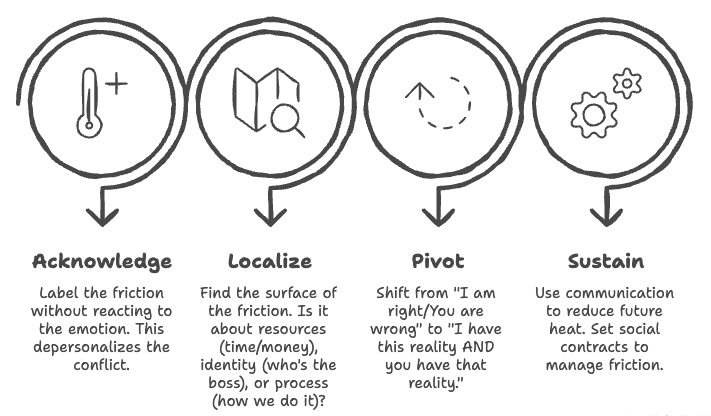
To deal with friction, I use the A.L.P.S. Protocol. This framework allows us to manage friction by transforming it from “abrasion” into “traction”; builds relational trust; creates smoother surfaces.
Takeaway
We spend our lives trying to engineer a “frictionless” world, but in physics, friction is what allows us to walk or stop cars. In your work and in your home, that subtle (or sharp) resistance when perspectives meet isn’t just drag; it’s frequently the quiet signal where real learning or better outcomes are beginning to form. To increase velocity; don’t just upgrade your CI/CD pipeline or buy fancy tools; stop adding more processes and build the relational equity - the trust and shared context—to truly move forward.
I’ll leave you with this question: If you could eliminate one piece of “Red Tape” today to make room for more “Golden Friction” in your life or work, what would it be?
« Silence